When Transaction Fees Swell: Why the Second Percentage Deserves a Column
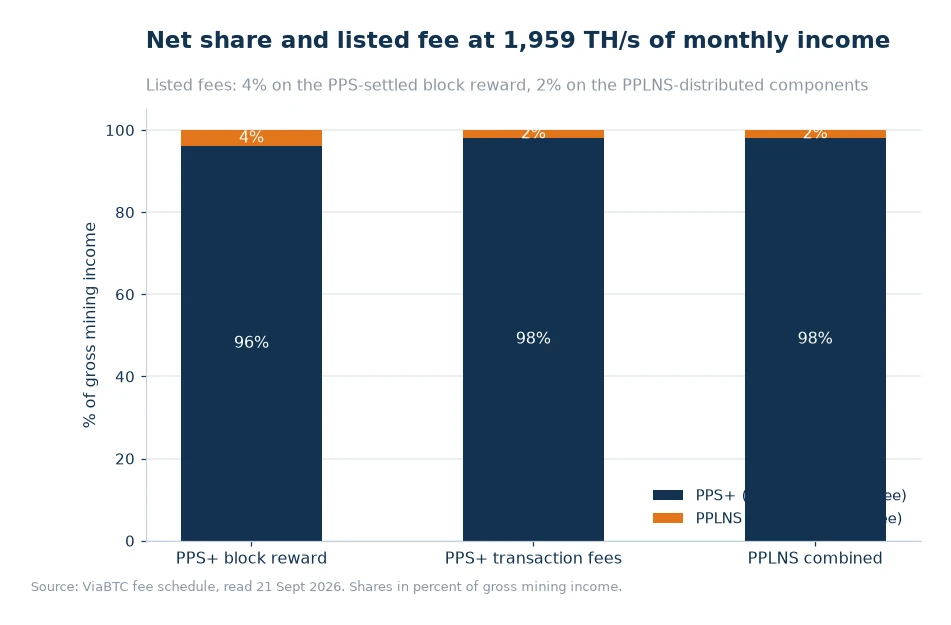
At 1,959 TH/s the day's gross is 0.00087884 BTC, or $74.43 at $84,692. The listed 4% on the block-reward component accounts for $2.98 of that, while the listed 2% on the transaction-fee component would account for $1.49 if it applied to the whole. It does not, and the difference between those two numbers is the reason a busy mempool changes the arithmetic.

Key takeaways
- 1,959 TH/s produces $74.43 of gross a day; a flat 4% on it would be $2.98.
- The subsidy is 3.125 BTC per block and does not move between halvings; fee income does.
- The listed 2% applies to the fee-derived slice, so a busy mempool lowers the blended rate.
- Model the fee share as a range, not a single number, when comparing schemes.
Two streams inside one block
A Bitcoin block pays the miner twice. The subsidy is new coins: 3.125 BTC per block, 144 blocks a day, 450 BTC across the network. The transaction fees are payments from users whose transfers are included in that block, and their total depends on how many people wanted space and how much they bid for it. The first stream is predictable to the satoshi. The second is not predictable at all.
A pool statement usually shows the combined result, which hides the split. That is fine for a wallet balance and unhelpful for a fee review, because the two streams are charged at different listed rates. Reading the statement as one number is what leads an operator to expect a fixed deduction and then wonder why it moved.
Why one stream moves and the other does not
The subsidy changes only at a halving. Between those events it is a constant per block, and with 144 blocks a day the network-wide issuance is fixed. Difficulty redistributes that constant among miners, but it does not change the total. A miner's subsidy income therefore rises and falls only with hashrate share.
Fee income follows demand for block space. A quiet week produces thin fees; a congested week produces thick ones. The same hardware can earn noticeably different totals in two consecutive weeks without any change in hashrate, and the difference sits entirely in the second stream. That is why a daily figure taken from a busy week should not be annualised without a caveat.
How the 2% line behaves as fees rise
The listed rate on the fee slice is lower than the rate on the subsidy slice, which means a larger fee share pulls the blended deduction down. Stated the other way: the periods when miners earn the most from fees are also the periods when the effective pool charge is lowest. The design is not accidental; fee income carries its own variability, and the lower rate reflects that.
At 1,959 TH/s, a day with no fee income at all would be charged close to $2.98. A day where fees make up a fifth of the gross would be charged about $2.68, and one where they make up two fifths about $2.38. The dollar difference is small in absolute terms, but it moves in the opposite direction to income, which is a useful property to understand before comparing two schemes on a single month's statement.
What the miner controls
Nobody at the pool controls the mempool, and nobody at the mine does either. What an operator can control is the estimate: use a fee-share range when modelling, keep the subsidy line separate, and avoid quoting a blended rate as though it were fixed. A model that says "between 3.2% and 4%" is more honest than one that says "4%" and breaks in a busy week.
The second lever is timing of decisions rather than of mining. Comparing two schemes during a congested week flatters the one with the lower fee rate; comparing during a quiet week flatters the one with the higher subsidy rate. Use a period long enough to include both, or normalise the fee share before drawing a conclusion.
Reading a statement that merges the streams
The ViaBTC Pool Fees schedule names the two components separately, but a monthly summary often presents one deduction figure. When that happens, the split has to be estimated before the blended rate means anything. Start with the gross, subtract the known subsidy charge at 4%, and treat the remainder as the fee-slice charge at 2%. If the remainder is negative, the statement is not showing what it claims to show and is worth a query.
Ask for the component view rather than reverse-engineering it every month. A pool that can show subsidy and fee income as separate lines makes the review a two-minute task, and it turns the annual comparison into a like-for-like exercise instead of a guess about which week the statement covered.
A column that changes the comparison
Add a fee-share column to the payout model. For each scenario, split gross into subsidy and fee income, apply 4% to the first and 2% to the second, and add the two charges. The result is a blended rate that responds to conditions instead of pretending they are constant, and it takes about ten minutes to build once.
The column also makes the chart's $2.98 legible. That figure is the ceiling: it is what the listed 4% would take if every dollar of gross came from the subsidy. Real statements sit at or below it, and the gap between the ceiling and the actual charge is a measure of how much fee income the period contained.
| Fee share of gross | Subsidy base | Fee base | Listed charge | Blended rate |
|---|---|---|---|---|
| 0% | $74.43 | $0.00 | $2.98 | 4.00% |
| 5% | $70.71 | $3.72 | $2.90 | 3.90% |
| 20% | $59.54 | $14.89 | $2.68 | 3.60% |
| 40% | $44.66 | $29.77 | $2.38 | 3.20% |
Worked example
Start from the full day, then split it two ways.
- Subsidy first: 144 blocks × 3.125 BTC gives 450 BTC a day.
- Split across 1,003,000,000 TH/s, each terahash earns 0.00000044865 BTC.
- 1,959 TH/s × 0.00000044865 = 0.00087884 BTC a day.
- At $84,692: 0.00087884 × 84,692 = $74.43.
- Ceiling case, all subsidy: 74.43 × 0.04 = $2.98.
- Twenty per cent fee share: subsidy 59.54 × 0.04 = $2.38, fees 14.89 × 0.02 = $0.30, total $2.68.
- Forty per cent fee share: subsidy 44.66 × 0.04 = $1.79, fees 29.77 × 0.02 = $0.60, total $2.38.
- Net at the 20% case: 74.43 − 2.68 = $71.75 a day, against $71.45 at the ceiling.
Frequently asked questions
Are transaction fees included in the hourly PPS+ credit?
The subsidy portion settles hourly against current difficulty. The fee portion is distributed under PPLNS logic over the recent window, so it arrives in a different rhythm even though both appear on the same statement.
Why is the fee-slice rate lower than the subsidy rate?
Because fee income is variable and the 2% reflects a different bargain from the 4% charged on the predictable subsidy slice. A higher fee share therefore lowers the blended deduction rather than raising it.
Should I model the fee share at today's level?
Model a range. The split moves with block-space demand, so a single number describes one week rather than a year, and the difference between 0% and 40% fee share is 0.8 percentage points of gross.
Track the split, not just the total
Once a month, write down the fee share of gross beside the total credit. Two or three of those entries turn the blended rate from a surprise into a trend, and the trend is what to use when a scheme decision comes up. The Statistics page supplies the network context, and the Profit Calculator supplies the gross at your hashrate.
At 1,959 TH/s the difference between the ceiling charge and a fee-heavy day is about sixty cents. Over a year it is small, but the habit of splitting the streams is worth more than the amount: it makes every later comparison, including a scheme change or a hosting quote, run on numbers that reflect how the income actually arrives.
Sources: ViaBTC fee schedule, statistics and calculator pages, read 21 Sept 2026[1]. Reference values: BTC $84,692; network hashrate 1,003 EH/s; difficulty 132.76 T; 3.125 BTC subsidy per block; 144 blocks a day. Published 24 Oct 2026; fee-share rows are illustrative scenarios.