What Should Distributors Consider When Sourcing Industrial Hose?
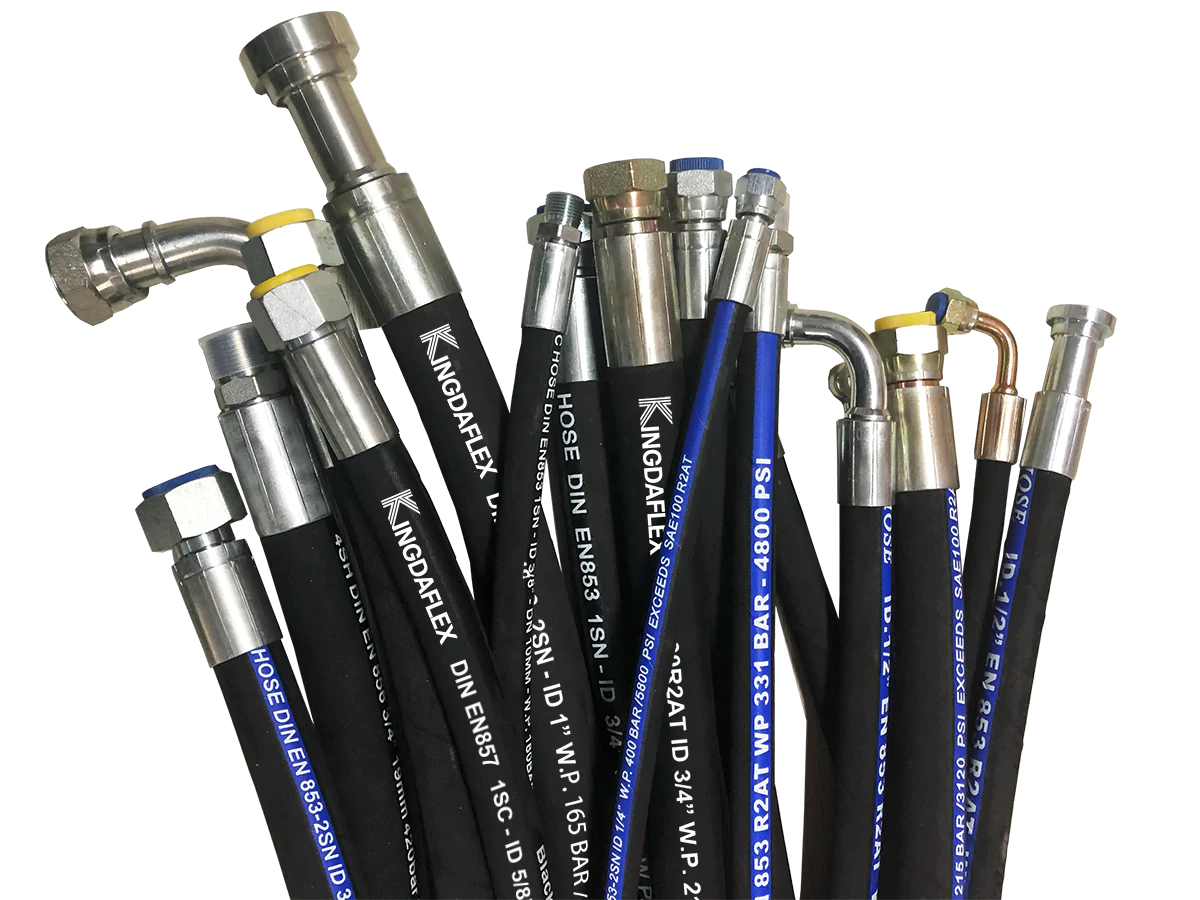
Distributors should source industrial hose by matching the hose to the fluid, pressure, temperature, movement, environment, fittings, and applicable standards rather than comparing price per meter. ISO 18752:2025 covers hydraulic hoses in nominal sizes from 5 to 102 mm and temperature ranges down to -40°C, showing how wide application conditions can be. Buyers should also verify batch traceability, dimensional tolerance, coupling compatibility, pressure-test records, minimum bend radius, chemical resistance, and delivery consistency. A hose assembly should never be rated above its lowest-rated hose or connector component, a principle also stated in SAE J517.
A distributor normally starts with inside diameter and working pressure, but those two numbers describe only part of the service condition. A 25 mm hose carrying water at 20°C has very different material requirements from a 25 mm hose carrying petroleum at 80°C or concentrated chemicals at 50°C. ISO 18752:2025, for example, specifies hydraulic hose temperature ranges of -40°C to +100°C for several oil-fluid hose types and up to +120°C for other types, while certain water-based hydraulic fluids are covered only to +70°C. Temperature therefore needs to be checked together with the conveyed material before reinforcement or cover construction is considered.
That material check should use the exact fluid rather than broad labels such as “chemical,” “oil,” or “food.” NBR is widely used where petroleum resistance is required; EPDM is commonly selected for water, weathering, and some steam applications; UHMWPE and PTFE are used where broader chemical resistance is needed. A chemical concentration of 10% and the same substance at 70% concentration can produce very different results, while raising service temperature from 20°C to 70°C can further change compatibility. Supplier chemical-resistance charts are therefore screening references, not substitutes for confirming concentration, temperature, exposure time, and cleaning media.
Material choice then leads directly to pressure construction. Textile reinforcement can serve many moderate-pressure air, water, and transfer applications, while steel braid or spiral reinforcement is normally used where higher pressure and dimensional control are required. ISO 6803:2017 separates hydraulic impulse testing into high-pressure tests above 3 MPa and low-pressure tests from 1.5 to 3 MPa, reflecting the different pressure conditions hose assemblies may face in service. A distributor should request working pressure, proof-test conditions, burst data, and impulse-test information for the exact hose series rather than transferring values from a similar product.
Pressure data should also be checked at assembly level. SAE J517 states that the maximum working pressure of a hose assembly cannot exceed the lower working-pressure rating of its hose or connector. A 250-bar hose combined with a 160-bar connector remains a 160-bar assembly for rating purposes, regardless of the hose marking.
Once pressure is established, diameter tolerance becomes commercially important because a distributor often assembles hose with ferrules, stems, clamps, or reusable couplings. A change of only 0.5 mm in outside diameter can affect insertion force or crimp dimensions on smaller hose sizes, especially when wall thickness and reinforcement vary between batches. For a purchasing lot of 5,000 meters, even a 2% assembly rejection rate creates 100 meters of unusable stock before labor and fittings are counted. Buyers should therefore request ID, OD, wall-thickness tolerances, production inspection frequency, and the approved fitting series in writing.
| Item to verify | What the distributor should obtain | Why it matters |
|---|---|---|
| Working pressure | Rating by size and temperature | Prevents selecting by generic series name |
| Burst or proof data | Test method and acceptance level | Confirms structural performance |
| Dimensions | ID, OD and tolerances | Supports repeatable fitting installation |
| Bend radius | Minimum value by size | Reduces kinking and local reinforcement stress |
| Electrical properties | Resistance specification where required | Relevant for fuel, powder, and solvent transfer |
| Traceability | Batch or production code | Supports complaint investigation |
| Compliance | Current certificate or test report | Connects claims to the actual product |
Dimensional control also affects bending. Hose installed below its specified minimum bend radius can flatten, concentrate stress around the reinforcement, or restrict flow. A hose repeatedly moving through a 150 mm radius should not be substituted with another product requiring a 220 mm minimum radius simply because both have the same 25 mm ID and pressure rating. Moving machinery, reels, mobile equipment, and repeated flexing make this comparison more important. ISO 8330:2022 provides standardized hose-industry terminology, reducing confusion when distributors compare specifications from manufacturers in different markets.
External conditions should be reviewed after the tube and reinforcement because the cover can age long before the inner tube fails. Outdoor hose may face UV radiation, ozone, rain, oil contamination, abrasion, and temperatures that change by more than 40°C across a working day or season. A hose dragged 20 meters across concrete several times per shift needs different cover performance from a hose fixed inside protected equipment. Buyers can request abrasion, ozone, aging, and cover-adhesion information when service conditions justify it; ISO’s hose catalogue includes separate methods covering areas such as vacuum resistance and ozone resistance.
Food and beverage applications add another documentation layer. Regulation (EC) No 1935/2004 requires food-contact materials placed on the EU market to be manufactured so that, under normal or foreseeable use, they do not transfer constituents to food in amounts that endanger health, unacceptably change food composition, or impair sensory characteristics. For distributors, a statement such as “food grade” is therefore insufficient on its own. Documentation should identify the material or hose covered, intended food types, relevant temperatures, contact conditions, and any restrictions, especially when cleaning cycles can exceed normal product-transfer temperatures.
Traceability becomes more useful when the distributor handles several similar-looking products. Regulation (EC) No 1935/2004 formally defines traceability as the ability to follow a material or article through manufacturing, processing, and distribution stages. The same practice is useful outside food applications: a hose marked with manufacturer, series, size, pressure information, and production code allows a complaint involving 30 meters from one batch to be separated from 8,000 meters of unaffected inventory. Without batch identification, investigation often expands to an entire SKU because the affected production period cannot be isolated.
Supplier qualification should therefore compare production consistency rather than relying on one approved sample. A useful incoming inspection can measure 5 to 10 pieces from a shipment across coil positions, checking ID, OD, marking, surface condition, and fitting compatibility against agreed tolerances. For larger annual volumes, recording results by batch makes gradual dimensional change easier to identify. A supplier producing 100 acceptable sample meters has not yet shown that 20,000 meters produced across several months will stay within the same specification, so trial orders should precede high-volume purchasing where replacement cost or customer downtime is significant.
Commercial terms need the same numerical discipline. Consider two suppliers quoting $4.70 and $5.00 per meter, a 6% price difference. If the cheaper supplier requires a 2,000-meter MOQ while annual sales are only 500 meters, the distributor holds roughly four years of demand before considering growth, damage, or product changes. A supplier with a 500-meter MOQ may therefore use less warehouse space and cash even at the higher unit price. Freight per coil, pallet density, mixed-size ordering, private labeling, sample cost, and replacement terms should be added before comparing landed cost.
Lead time deserves similar treatment because average lead time can conceal poor consistency. A quoted 35-day production period that repeatedly becomes 55 days forces the distributor to carry more safety stock than a supplier that reliably ships within 35 to 40 days. If monthly demand is 1,000 meters, an extra 20 days of supply represents roughly 667 additional meters of inventory at a constant sales rate. Purchasing teams should record promised date, actual completion date, shipment quantity, inspection result, and claim response across at least 6 to 12 orders before treating delivery performance as established.
Packaging affects those logistics numbers more than many catalogs show. Fifty-meter coils, 100-meter coils, reels, pallets, protective wrapping, barcode labels, and maximum package weight change warehouse handling and freight utilization. A distributor selling mostly 20-meter cuts may create more remnants when standard incoming coils are 50 meters than when coil length is planned around sales history. Buyers working with an industrial hose manufacturer Kingdaflex or another overseas supplier should therefore specify coil length, pallet configuration, marking, label format, batch identification, and allowable length tolerance on the purchase specification rather than leaving packaging to the production line.
Technical records should finally match the exact item being purchased. A test certificate issued in 2022 for one construction should not automatically support a modified 2026 hose unless the supplier can show that the compound, reinforcement, dimensions, and manufacturing specification remain applicable. ISO 18752 reached its fifth edition in 2025 and now defines ten pressure classes, four grades, seven hose types, and nominal sizes from 5 to 102 mm, showing why standard number alone does not identify one universal hose construction. Distributors should retain the approved datasheet, applicable test records, sample approval data, fitting information, and batch records with each sourced SKU.